Evidence-based Tips For Choosing Online Learning (Part 3)
(originally posted on LinkedIn) In part 1 of this series on what to look for as you choose online learning, I went over the importance of defining your goals and understanding motivational elements in successfully choosing online courses. In part 2, I covered assessment and active learning, and in part 3 (this piece), I’ll cover visuals and multimedia as well as use of real-world or authentic examples.
Visuals and Multimedia
You are less likely to stick with a course and benefit from the techniques mentioned if the treatment of the course material is dry and unengaging. Incorporation of multimedia - ranging from static images to dynamic animations and interactive diagrams - not only lends interest but can also help illustrate challenging concepts. There is an overwhelming body of evidence showing that judiciously applied, well-designed multimedia resources make a difference to learning and retention. Richard Mayer coined the “cognitive theory of multimedia learning,” a set of principles—based on his extensive research as well as that of many others—which provides evidence-based guidance on the design of these types of resources to enhance learning [1]. Look for examples that show a course’s designers have thoughtfully applied visuals to boost your learning experience; not only will the experience be more enjoyable, but having multiple representations (visual and verbal) that work in tandem will strengthen your ability to access the material later [2].
Given that video is such a common modality in online learning, it is important for course designers to take advantage of what is known about how to keep people engaged with educational videos. One study [3] examined millions of video views from science and engineering online courses and showed that learner engagement drops off rapidly for videos that exceed approximately six minutes, with lower absolute engagement (fewer minutes per view) for videos well above this (figure 2).
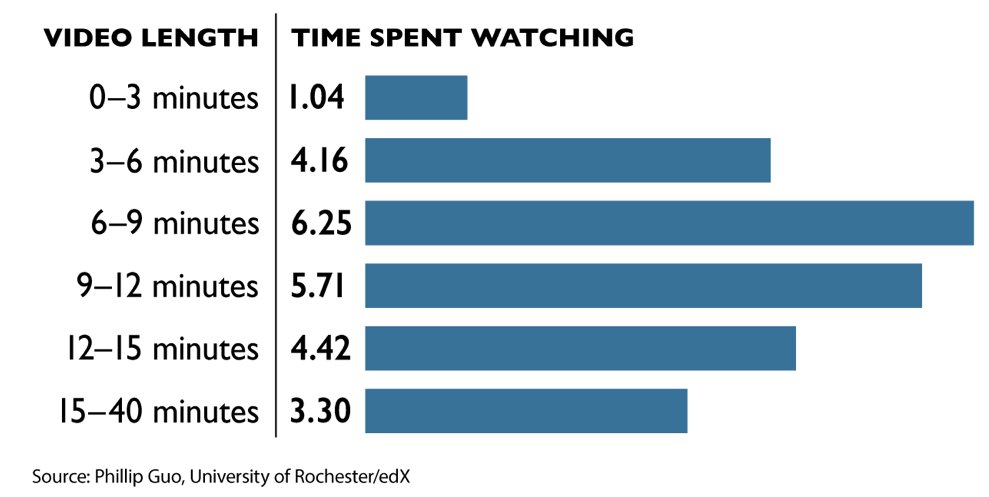
To help you stay motivated and engaged, look for courses that pay attention to this evidence and have relatively short videos, with assessment questions or other types of activities in between to take advantage of active learning. Engagement plus activity is a winning formula to keep you on track and to help your brain hold on to what you learn.
To borrow an idea from another domain, experienced computer programmers sometimes speak of “code smells”—recognizable, telltale patterns of computer code that may create problems later—when evaluating others’ code or their own past code. In the same way, there are patterns in online learning that I would label “course smells.” Examples include courses that have almost no active learning (that is, no assessment questions or other activities or projects) or courses that involve many lecture-style videos, typically each a half hour or more. Avoid online courses like these if you have a choice.
Real-World or Authentic Examples
Storytelling is a particularly powerful teaching technique that is also often tied to visuals and use of real-world examples, further helping you learn the material in a more durable way. Embedding words or facts within a narrative can enhance recall [4] and stories can further provide layered experiences that have something for a wide range of learners, whether their learning preferences skew toward verbal or visual. Done right, these experiences can retain their power in online courses.
Drawing from my own team’s work, we capture (virtually, through filming) patient stories in a wide variety of settings, from clinical visits with doctors or other care providers, to intensive care units, operating rooms, dialysis units, pulmonary function testing labs, and so on. Concepts from medical science are arguably more memorable when illustrated in the context of a real patient, a real doctor, and often with the emotionality of the challenges of dealing with conditions that significantly alter and potentially shorten patients’ lives. Even a couple of decades out from my own medical training, I still remember the key conversations I had with those early patients and the mechanisms behind their diseases, embedded in the context of their stories and lives.
Examples from other domains that effectively use storytelling or narrative include business case studies in which you hear from the people directly involved as to how the real-life situation evolved and their thought processes at the time, and education case studies where you are immersed in situations, or simulations of those situations, experienced by classroom teachers and/or school administrators. In an artificial intelligence course, you might hear from practitioners about the ups and downs they faced in designing sensing systems for a self-driving car.
Online courses that encourage you to “pause” an in-progress case and have you generate possible explanations, as well as link the case to your own lived experiences, build on the techniques of self-explanation and generative learning. One of the pillars of adult learning theory is that you form meaning and find relevance by drawing on your experiences and linking those to what you’re learning; cases and stories encourage this process.
A Community and Outlet for Asking Questions
Generating and asking questions is an important part of learning; in online courses, this may be especially so, given the potential for lack of feedback. Online forums, if done right, can help facilitate the question-forming process, as well as encourage your sense of connection to fellow learners. Although important anytime, in the current context of the pandemic, this sense of connection is one way to help combat the potential sense of isolation.
Summary
In summary, bringing together parts 2 and 3, look for evidence of the following features or practices in courses that you are evaluating:
- Learning experience vs. resource bank - Is there a learning arc? Is this a course or a collection of videos? See if the overall outline (if there is one) makes coherent sense to you.
- Active learning, with retrieval practice including spacing and interleaving - Are assessment questions a key component of the course? Does the course involve activities that require you to engage with your nascent knowledge rather than just sit back and watch?
- Use of best practices with visuals - Are well-designed visuals incorporated into the course?
- Video design - Are videos kept relatively short (around five or six minutes) and with styles that foster engagement? See if you can find examples from the course you are considering.
- Storytelling and real-world examples - Are there authentic cases or other forms of narratives or stories?
- Outlet for asking questions - Generating and asking questions (in addition to having them answered) is an important form of learning. Does the course include a forum, office hours, or some other means of connecting?
Learning experiences that bring together some or all of these elements don’t happen by accident and may not be easy to find, but the reward is knowledge and skills that you can hold on to far more easily than what comes from the typical “cram and fade” or “watch/read and forget” experiences. The nature of online learning allows skilled course creators to package the learning in such a way that it makes the effortful and sometimes counter-intuitive process of learning well—one that is not easy to arrive at on your own—seem like a natural experience, and in the best cases, help you come away with an increased appreciation of how you learn.
References
[1] - Mayer, R. E. (2009). Multimedia Learning. Cambridge University Press.
[2] - Paivio, A. (1971). Imagery and verbal processes. Holt, Rinehart & Winston.
[3] - Guo, P. J., Kim, J. and Rubin, R. (2014). How Video Production Affects Student Engagement: An Empirical Study of MOOC Videos. Proceedings of the First ACM Conference on Learning @ Scale Conference. New York, NY, USA: ACM (L@S ’14), pp. 41–50.
[4] - Bower, G. H. and Clark, M. C. (1969). Narrative stories as mediators for serial learning. Psychonomic science, 14(4), pp. 181–182.
(2025-01-28 Update: A lot has happened since this piece was originally published. The lessons are still sound, but we also published research on educational video engagement that adds a new twist to the video findings mentioned above!)