How a Startup within Harvard Medical School Is Transforming Medical Education
(originally posted on LinkedIn) The American health care landscape is shifting rapidly, and on multiple fronts—from scientific breakthroughs to economic and policy developments—and Americans are paying attention. Companies, politicians and the public alike are more closely attuned to medicine than ever before, and stakeholders at all levels are focused on finding new ways to make health care more accessible and affordable without compromising its quality.
Within this environment of rapid change and increased awareness, medical education has been pressed to keep pace. At the same time that we see a projected shortage of doctors and nurses over the next five to ten years—the American Association of Medical Colleges predicts a shortage of up to 95,000 physicians over the next decade and the Bureau of Labor Statistics predicts up to 1.1 million vacancies emerging for registered nurses by 2022—we are also confronted with training a new generation of health care providers who will need to keep up with the sophistication of new advances in medical science and treatment.
Among medical professionals and general consumers alike, an understanding of foundational medical science is becoming increasingly important, particularly in light of the growing availability of new treatments and sources of data that inform risk and therapeutics. Examples of these advances range from direct-to-consumer genetic testing (e.g., via 23andMe) and genome sequencing, to immunotherapy for cancer, and evolving areas like these share a level of complexity that demands a new basic medical science “literacy” by those in health care.
In thinking about how to influence a greater number of highly talented individuals to enter health care, as well as to equip those individuals with the tools to keep up with understanding the exciting strides in medical science, we at Harvard Medical School realized that it was critical to look beyond what we can do on our campus.
Formation of HMX
We saw an opportunity to better prepare aspiring medical students by rethinking the way medicine is taught, not just on our campus but across the country and the world. In 2014, we formed HMX, in essence a startup within Harvard Medical School, and began gathering an interdisciplinary team of clinicians, educators, and creative professionals that could build and scale the most immersive online program possible. Our goals have been to inspire and educate in a way that democratizes medical education, while incorporating advances in learning science and biomedical visualization, and to extend our impact beyond the walls of our school to reach learners with a strong interest in health care, but who may not yet be in formal training programs.
As we built the team and the initial set of courses, we adopted “lean startup” principles and piloted material with schools, embracing a ‘build-measure-learn’ iterative cycle. At this point, we’ve had over 20 fully online course runs, and each has provided a tremendous amount of feedback and data. Instead of an iteration cycle measured in semesters and years, we are able to make improvements on a month-by-month basis. As a result, having applied (and continuing to apply) the learnings from these experiences, online HMX courses have evolved to be rigorous enough to be highly useful as preparation for our incoming students and, at the same time, engaging and accessible enough to be of broad interest to a variety of levels of learners.
Launch of HMX Fundamentals
Taking these lessons to a wider audience, in June of 2017, we launched HMX Fundamentals—a digital-first, digital-only form of medical education designed for aspiring medical professionals who are interested in or just beginning a career in health care. Instead of a lecture-based face-to-face format, HMX Fundamentals takes advantage of the latest technologies—including narrated videos, interactive modules, and state-of-the-art visualizations—to clearly explain some of the most complex but crucial concepts in medicine. The program offers courses in Physiology, Immunology, Genetics and Biochemistry—four subjects essential to anyone working in health care and vitally important in understanding the future of medicine. Courses also emphasize active learning, with assessment questions interleaved throughout (with a final exam at the end), note taking guides for each lesson, and online discussion forums facilitated by moderators from Harvard Medical School with expertise in the subjects covered.
One of the most revolutionary features of HMX Fundamentals is the access to authentic experiences that tie together basic medical science with patient care. As part of the online courses, we take students virtually inside Harvard hospitals, and regularly show clinical examples with real patients and doctors that link to and reinforce the content students are studying.
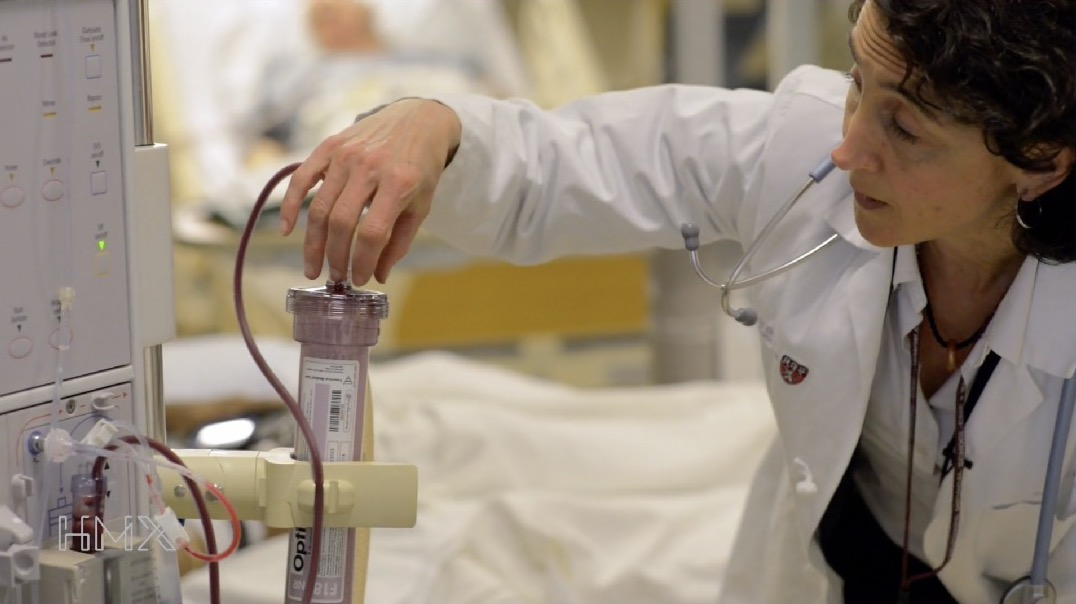
Reading about concepts like oxygen transport, oxygen demand, or body fluid compartments is one thing, but seeing those ideas applied in the courses, including with a real patient on a ventilator in the intensive care unit, a patient undergoing a cardiac catheterization for suspected coronary artery disease, and a patient with end stage kidney disease on a dialysis machine, provides a link between fundamental science and bedside experience that is not soon forgotten. In addition, seeing the respect and care with which doctors interact with their patients—and seeing those interactions across a diverse set of clinical encounters—forms a similarly lasting impression. Traditionally, medical education offers few if any opportunities for students to experience clinical settings and truly understand the relevance of what they’re learning until one or more years into a program.
Impact and Feedback
This approach turns out to be meaningful for a far greater audience than just pre-medical students, and we’ve seen a positive reaction from professionals whose work may benefit from greater insight into medicine and the workings of the human body. As one of our corporate learners recently shared, “The learning objectives at the beginning, then all of the concepts through the story and the videos, and then the linkage to disease, I thought that was amazing. For me that was the most valuable part actually. Ok I’ve learned this in theory and then the videos where you’re going in the cath lab, or there was a lesson with melanoma - I thought that was amazing. That’s the value of this course. I cannot go to a hospital and see, but being able to tie those things together is the real value…”. With relevant content that keeps learners motivated and engaged, and the ability to earn a certificate from Harvard Medical School that shows serious achievement, there is high value for a range of learners.
One characteristic that many of our learners share, regardless of whether they are incoming medical students or working professionals, is limited time to devote to formal learning. We recognize that the pace of change and the scarcity of people’s time demand an updated way of helping people learn durably and efficiently, based on cognitive science, and one that provides a solid conceptual framework on which future learning can occur. By taking advantage of learning science, via principles like interleaving, spaced repetition, and elaboration that utilize knowledge of how the brain forms memories and connections, we are able to create courses that provide highly effective ways of acquiring an understanding of fundamental medical science within an achievable time commitment that fits busy schedules. Think of this approach as analogous in some ways to designing cardiovascular workout routines based on scientific principles to give the maximum benefit within a fixed duration.
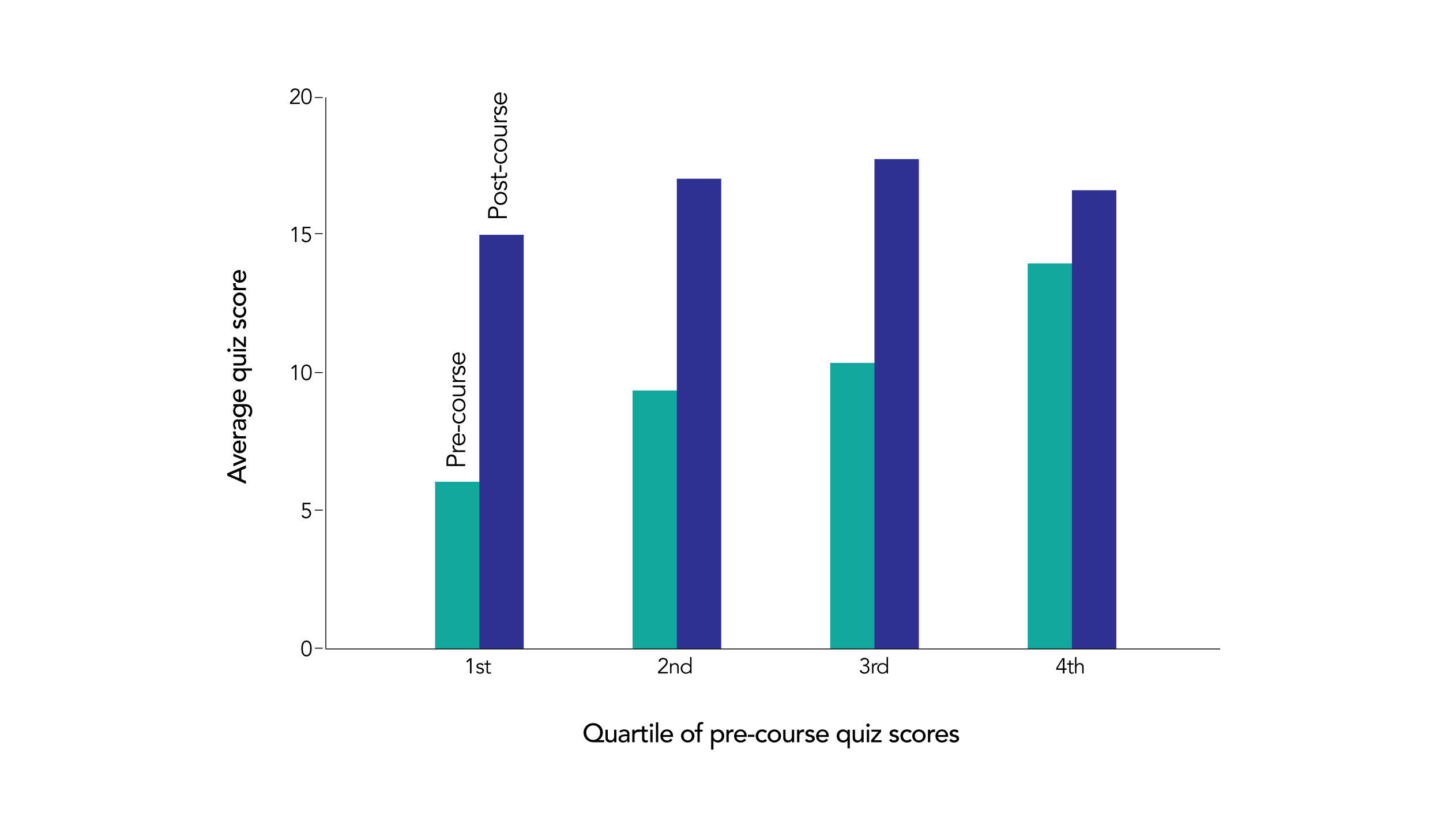
And it makes a difference. While we’re still in the early stages of this educational venture, like other startups, we take the pulse on our effectiveness by looking at metrics like the learning gains of our students. Students across the courses have reliably shown incredible gains, as high as 80-90 percent in some cases from pre-course to post-course quizzes. Excitingly, students from all prior levels of knowledge seem to benefit, offering the promise of ‘leveling the playing field’ for learners with a diverse range of backgrounds.
With HMX Fundamentals, we believe we’ve taken a step toward what medical education can and should be. Medical education must continue to change to reflect the needs of the industry, and open more doors to more students considering a career in medicine as well as others with an interest in the science of health care. By opening our own doors to exponentially more students, we’re confident we can build the pipeline and make a positive difference for the next generation of health care providers.
To learn more about HMX Fundamentals, please visit: onlinelearning.hms.harvard.edu/hmx.